
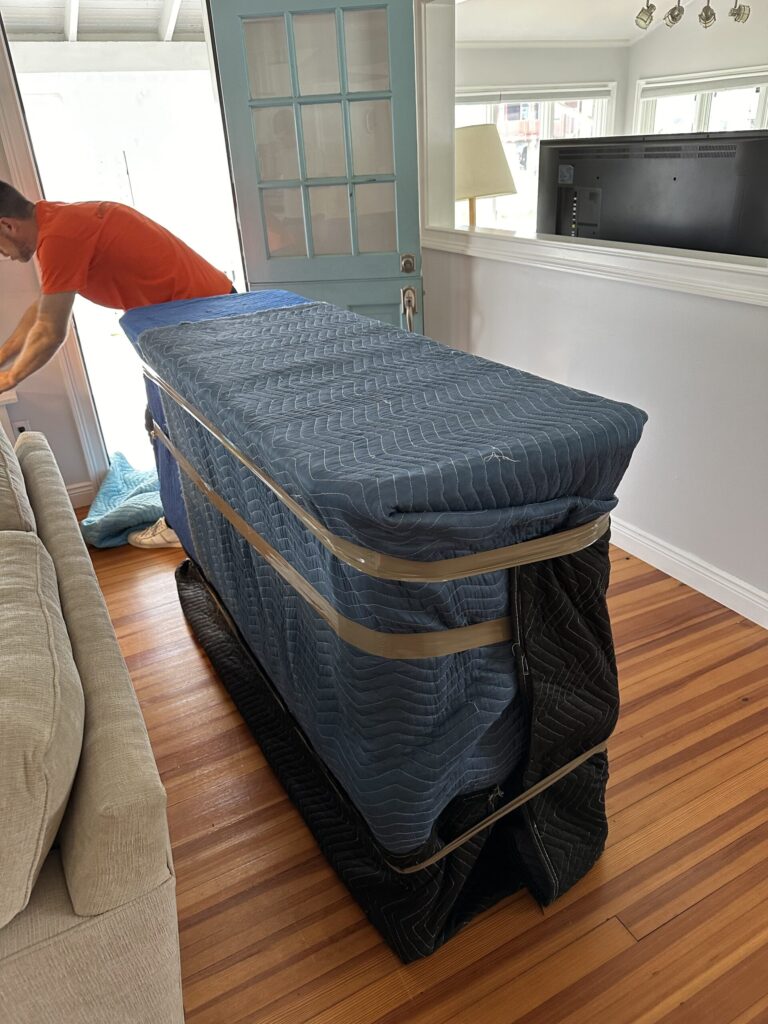
Some pieces of furniture seem almost impossible to remove from the homes they occupy. A large piano sitting inside an older property can be one of the clearest examples, especially when the route outside includes narrow doorways, tight hallway corners, steep stairs, or small landings.
It can leave homeowners wondering how the instrument ever entered the property in the first place. In some cases, the surrounding space can make it seem as though the house was practically built around the piano.
The solution to difficult piano moves is not simply adding more people and attempting to force the instrument through. Pianos combine substantial weight with an awkward shape, delicate components, and a weight distribution that can make them challenging to control. The property itself also needs to be considered, since forcing an item through an unsuitable route can damage floors, walls, doorframes, or the instrument.
Continental Moving approaches these situations by first determining what is physically possible. Measurements, access conditions, potential exit routes, equipment requirements, and opportunities for appropriate disassembly all need to be considered before the piano starts moving. What initially looks like an impossible move can often become much more manageable once the problem is broken into individual stages.
Planning Piano Moving Services Around the Property
Professional piano moving services begin with understanding both the instrument and the building around it. Before deciding how a piano should leave the property, the moving team needs to assess the complete route from its current position to the truck.
Measurements provide the starting point. The length, width, and height of the piano need to be considered alongside any parts that affect its overall dimensions. The crew can then compare those measurements with doorways, hallways, staircases, landings, and other potential restrictions.
A doorway that appears wide enough at first glance may become more challenging once the angle required to approach it is considered. Similarly, a piano may fit through a hallway but still lack sufficient room to make the turn required at the end.
Staircases introduce another set of considerations. The crew needs enough space to maintain control of the instrument while accounting for the direction of travel, available clearance, and where individual movers can safely position themselves. This is why looking at measurements individually is not enough. The team needs to understand how the dimensions interact throughout the complete route.
The most obvious exit is not automatically the most practical one either. Different doors or other suitable access points may provide better clearance depending on the layout of the property. Assessing those possibilities before attempting the move gives the crew an opportunity to compare routes and determine which creates the most controlled path outside.
Finding Solutions for Difficult Piano Moves
Some difficult piano moves require more than following the normal route through the front door. When measurements show that the instrument cannot safely navigate an opening or turn, the next step is to determine what can reasonably be changed.
Suitable parts of the piano may be removable depending on its design. Components such as legs or other appropriate nonstructural elements can sometimes be taken off to reduce the dimensions of the instrument and create additional clearance.
Doors may also be removable from their hinges where doing so creates useful additional space. These seemingly small adjustments can make an important difference when the measurements are extremely close.
The crew still needs to consider what happens after the restricted point. Getting through one doorway achieves little if the piano then reaches a hallway corner or staircase it cannot navigate. That is why the route should be considered as a complete sequence rather than a collection of individual obstacles.
Where conventional routes are unsuitable, other possibilities may need to be assessed. Depending on the property, instrument, and conditions, an alternative opening or more specialized handling approach may provide another option.
More complex solutions require particularly careful evaluation. The fact that an alternative route exists does not automatically mean it is suitable. The crew needs to consider the instrument, property, available working space, equipment requirements, and risks associated with the approach.
Experienced movers also need to know when to stop and reassess. If the instrument encounters unexpected resistance, forcing it forward can turn a difficult move into property or furniture damage. Pausing allows the crew to understand why the original plan is not working and determine whether positioning, protection, disassembly, or the route itself needs to change.
Using the Right Equipment and Team Coordination
Once the route has been established, the equipment needs to match the specific requirements of the move. Moving blankets and appropriate padding help protect the piano’s exterior, while specialized moving equipment can support its weight and provide greater control during different stages of the relocation. Straps and other securing equipment can also help the crew maintain stability as the instrument changes position.
The exact equipment required depends on the piano and access conditions. Moving an upright piano through a relatively open ground floor property presents a different challenge from maneuvering a large instrument through confined hallways or stairs. Equipment alone does not solve the problem. The moving team needs to understand how and when each piece should be used.
Coordination becomes especially important in confined spaces. A piano may require several movers to control its weight, but narrow hallways and staircases can limit where those people are able to stand. Every member of the crew needs to understand the planned movement before it begins. One person may need to guide the direction while others control the weight and positioning of the instrument.
Clear communication helps the group move as a single team rather than having individual movers react independently. This becomes particularly important during turns, changes in elevation, or other points where the instrument needs to be repositioned.
A controlled pace also gives the team time to monitor clearance. Moving a heavy piano inch by inch through a difficult section may take longer, but maintaining control is more important than attempting to complete the maneuver quickly.
Experience becomes valuable when conditions differ from what was expected. An uneven floor, unexpected threshold, tighter turn, or other obstacle may require the original plan to be adjusted. Rather than relying on physical force, the crew can reassess the position of the instrument and determine what needs to change before continuing.
Protecting the Piano and Property Throughout the Move
Successfully removing the piano is only part of the job. The instrument and the property both need to remain protected throughout the process. The route should be prepared before the piano begins moving. Floors and other vulnerable surfaces can receive appropriate protection based on the conditions inside the home, while the instrument itself can be wrapped and padded before it enters tighter areas.
This preparation becomes particularly important when clearances are limited. A narrow hallway or doorway leaves less margin between the piano and surrounding surfaces, so controlled movement and suitable protection need to work together. Corners, walls, floors, and doorframes may all require consideration depending on the route. The objective is to move the instrument without turning the surrounding property into part of the moving equipment.
Protection needs to continue once the piano reaches the truck. The instrument still has to be loaded, secured for transportation, unloaded at the destination, and moved through another property before reaching its final position.
The destination needs the same planning as the origin. A piano that can successfully leave one home may encounter an entirely different set of stairs, doors, or hallway dimensions at the new address. Reviewing both sides of the move helps Continental Moving prepare for the complete relocation rather than concentrating solely on getting the piano out of its current room.
The piano that appears to have been built into the house is ultimately a problem of planning rather than brute strength. Measurements establish what will fit, route assessment identifies the available options, appropriate equipment provides greater control, and coordinated handling helps the crew execute the plan.
Some instruments will require straightforward solutions, while others may need disassembly, an alternative route, or a more specialized moving approach. The important step is determining those requirements before attempting to force the piano through a space that cannot accommodate it.
That preparation turns an apparently impossible situation into a series of practical decisions. It also protects the instrument, the property, and the people responsible for completing the move. If you are facing a complex relocation challenge and need expert piano moving services to move your valuable instrument safely, contact our experienced team today to request a personal consultation.
