
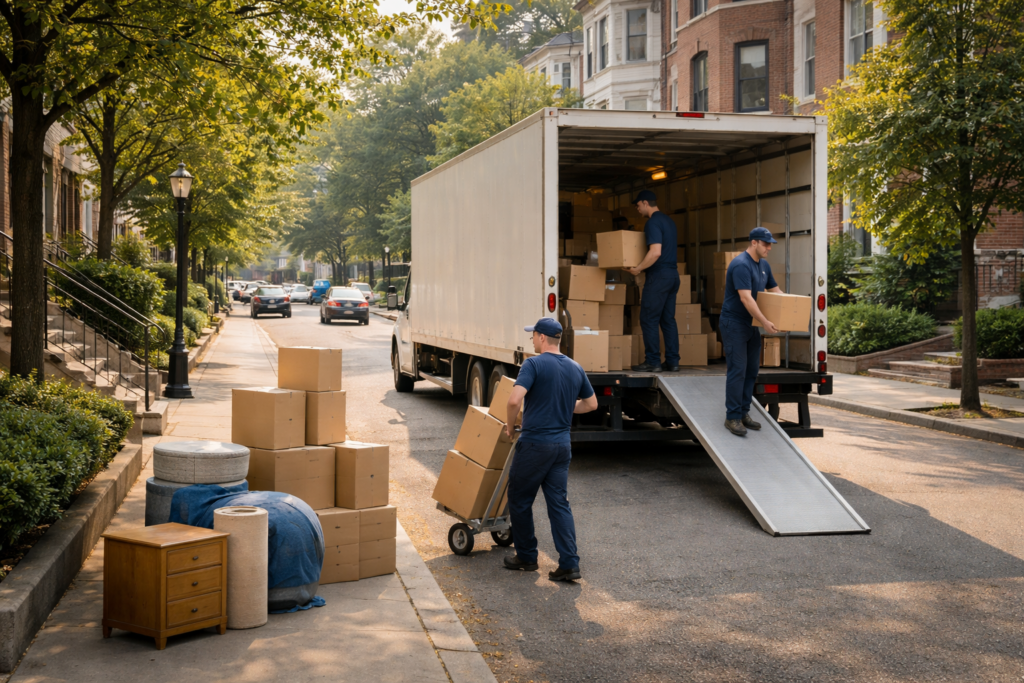
Moving heavy belongings requires more than having enough people available to lift them. Weight, dimensions, balance, access conditions, and the type of item all influence how it should be moved safely from a property and into the truck.
For many household belongings, standard moving equipment and ramp loading provide a practical solution. Boxes, conventional furniture, and other manageable items can be moved using dollies, straps, ramps, and established lifting techniques.
Some belongings present a different challenge. Large appliances, particularly heavy furniture, commercial equipment, and specialty items may be difficult to control on an inclined loading ramp. In these situations, mechanical assistance can give the moving crew greater control during one of the most challenging parts of the move.
Continental Moving can use lift gate assistance when the requirements of a particular item or relocation make it appropriate. A hydraulic lift gate provides a powered platform at the rear of the moving truck, allowing suitable items to be raised from ground level to the height of the truck bed.
Instead of requiring the crew to move a particularly heavy item along an inclined ramp, the lift gate handles the vertical movement. Movers can then concentrate on positioning, stabilizing, and guiding the item as it transitions into the truck.
Determining whether this equipment is required is part of planning the move properly. The objective is not to use specialist equipment unnecessarily, but to recognize situations where it can make handling safer and more controlled.
Recognizing the Value of a Lift Gate Moving Service
A loading ramp works effectively for a wide range of household and commercial belongings. The challenge increases when an item becomes particularly heavy, difficult to balance, or awkward to maneuver.
Moving substantial weight along an incline requires the crew to control both the item and the effect of gravity. If the object is unusually large or difficult to grip, maintaining that control can become more challenging. A lift gate moving service provides another option by allowing suitable items to remain on a relatively level platform while they are raised to the truck bed.
Before the lift begins, the moving crew needs to position and stabilize the item appropriately on the platform. Once secure, the hydraulic system can raise it to the required height, where the movers can guide it into the cargo area. This can reduce the amount of manual force required during the vertical transition. Instead of concentrating on pushing or controlling an item along a ramp, the crew can focus on its position and stability.
A lift gate moving service can be useful for belongings where weight is only one part of the challenge. An item with an unusual shape or distribution of weight may require additional control even when experienced movers are available.
Large appliances and substantial pieces of furniture are potential examples. Some specialty belongings can also require equipment selected specifically around their construction, dimensions, and handling requirements. The correct approach should be determined by the individual item rather than assuming every heavy possession needs to be handled in exactly the same way.
Commercial relocations can present similar challenges. Businesses may need to move equipment, large displays, machinery, or other substantial assets that are not suited to conventional household moving methods. In these situations, understanding the equipment requirements before moving day allows Continental Moving to prepare the appropriate truck and handling tools for the job.
Prioritizing Crew Safety and Equipment Protection During Heavy Item Transport
Safe handling is particularly important when weight and size increase. Movers need to maintain control of the item while also protecting themselves, the customer’s belongings, and the surrounding property.
Mechanical assistance can reduce some of the physical demands involved in heavy item transport. A lift gate handles the movement between ground level and the truck bed, limiting the need for movers to manually control substantial weight along an inclined loading surface.
That does not remove the need for experienced handling. Heavy items still need to be moved through the property, positioned on the platform, stabilized during lifting, and secured appropriately once inside the truck. Planning each stage helps the crew determine where mechanical assistance provides the greatest benefit.
Property access also influences the approach. Tight doorways, stairs, narrow hallways, uneven exterior surfaces, and limited loading space can all affect how a large item needs to travel between its original location and the truck. Protective measures remain important throughout this process. Moving blankets, appropriate wrapping, straps, floor protection, and other equipment can be used according to the item and property conditions.
Once the item reaches the lift gate, maintaining stability becomes the priority. The crew can position it appropriately before operating the platform and then guide it into the truck once the lift reaches cargo height.
The same care applies during unloading. The item needs to be moved from its secured position inside the truck onto the lift gate before being lowered in a controlled manner to ground level. From there, the crew can continue moving it into the destination property using the equipment and handling approach appropriate for the conditions.
Planning for Heavy Items Begins Long Before Moving Day
Planning for heavy item transport should begin before the moving truck arrives. During the estimate or initial consultation, Continental Moving can gather information about particularly large, heavy, or unusual belongings that may require additional consideration.
Dimensions, approximate weight, construction, and accessibility can all help determine what equipment will be needed. The layout at both the origin and destination should also be considered because a lift gate only addresses one stage of the item’s journey.
For example, a heavy piece may be straightforward to load mechanically but still require careful planning to move through a narrow entrance or reach an upper floor. Understanding these conditions beforehand allows the crew to prepare for the complete route rather than focusing solely on loading the truck.
This preparation also helps avoid moving day surprises. Discovering that an item requires different equipment only after the crew arrives can create unnecessary delays and complicate an otherwise organized relocation.
Professional moving is not simply about applying more physical strength to difficult items. It is about understanding the challenge, selecting appropriate equipment, and establishing a controlled process for getting each belonging safely from its starting point to its destination.
A lift gate is one of the tools Continental Moving can use when particularly heavy or difficult items make standard loading less suitable. When appropriate, hydraulic assistance can reduce physical strain during loading and unloading while giving the crew greater control over the item.
If your upcoming move includes large appliances, substantial furniture, commercial equipment, or other specialty belongings, let Continental Moving know during the planning process. Contact Us today to discuss your moving requirements and determine the equipment needed for your relocation.
