
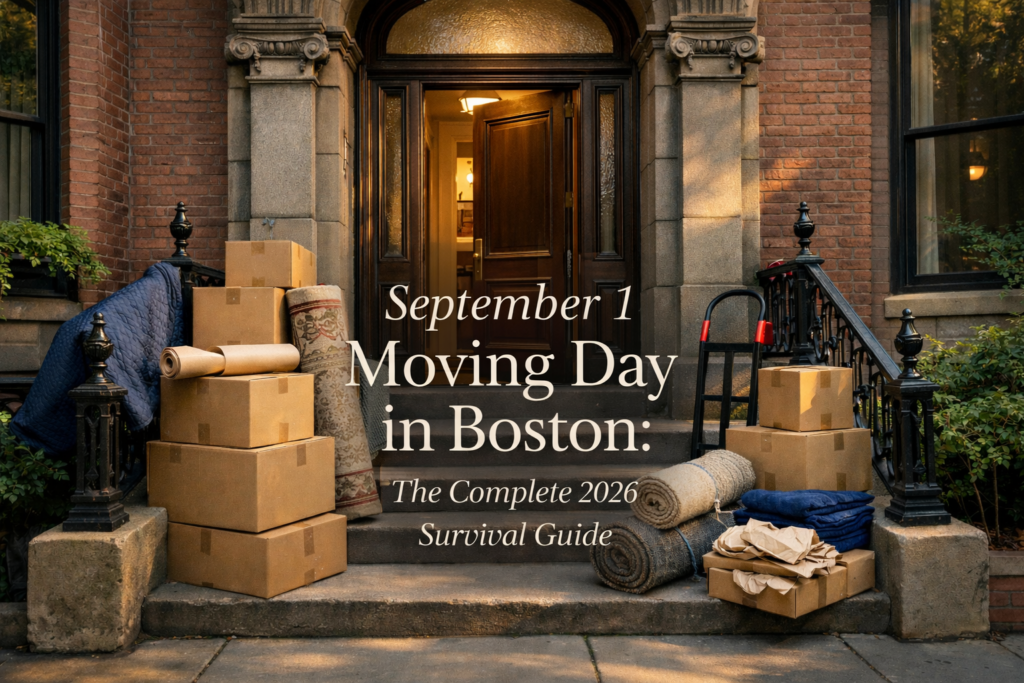
Quick Answer: September 1 is Boston’s busiest moving day because most rental leases start and end at the same time. If you are moving on or around that date, book your movers 6 to 8 weeks early, secure your parking permit in advance, pack ahead of time, and avoid high-traffic neighborhoods and routes like Storrow Drive. Planning early is the best way to reduce stress, delays, and extra costs.
Every year on September 1, something happens in Boston that does not happen in any other major American city. Roughly 70 percent of the city’s rental leases turn over on the same day. Tens of thousands of residents, many of them college students, pack their belongings into trucks and try to move through streets that were designed for horse-drawn carts, not a fleet of 26-foot box trucks competing for the same parking spot.
The result is a citywide event that Bostonians call Moving Day. Traffic grinds to a halt. Sidewalks overflow with discarded furniture. Double-parked trucks block entire blocks. And if you have not planned ahead, you may find yourself without movers, without a parking permit, and without a way to get your sofa through a third-floor doorway that turns out to be four inches too narrow.
This guide will walk you through everything you need to know to survive September 1, 2026, whether you are a first-time renter, a returning student, or a family navigating the Boston lease cycle for the first time.
Why Does Boston Move on September 1?

Boston’s September 1 moving tradition dates back more than a century. The earliest known reference appeared in the Boston Globe on September 1, 1899, describing residents returning to the city from the countryside at the end of summer to prepare for the school year. The tradition stuck because Boston is, at its core, a college city. With more than 150,000 students enrolled at universities across the metro area, landlords long ago aligned their lease cycles to the academic calendar.
Today, the result is a rental market where the vast majority of leases begin and end on the same date. According to data cited by multiple sources, approximately two-thirds to 70 percent of Boston leases follow this cycle. That concentration creates an annual bottleneck where thousands of people try to move in, move out, and cross paths on the same narrow streets within the same 12-hour window.
The City of Boston reported that in 2023, Moving Day produced 38 tons of waste and 1,700 abandoned mattresses. More than half of all moving permits issued annually are requested between June and August, with 16,000 to 20,000 permits issued during that period alone. The neighborhoods hit hardest are the ones with the highest renter and student populations: Allston, Brighton, Fenway, Mission Hill, the South End, and South Boston.
What Is Allston Christmas?

If you have never heard the term, Allston Christmas is the local name for the phenomenon that unfolds on the sidewalks of Allston and Brighton every late August and early September. As thousands of tenants leave their apartments, they abandon furniture, appliances, and household items that they cannot or do not want to move. Couches, bookshelves, desks, lamps, kitchen supplies, and sometimes surprisingly good finds line the curbs for anyone willing to pick them up.
For new residents and students arriving on tight budgets, Allston Christmas is a genuine opportunity. It is not uncommon to furnish a studio apartment almost entirely from curbside finds. The best items disappear quickly, often before sunrise, so experienced scavengers start early and bring gloves, a flashlight, and a friend who can help carry a dresser up three flights of stairs.
A word of caution: inspect everything carefully before bringing it inside. Mattresses and upholstered furniture can harbor bedbugs, which are a serious problem in densely populated neighborhoods. The City of Boston now requires residents to schedule mattress pickups rather than leaving them on the street, and fines apply for illegal dumping.
The 8-Week Countdown: Your Week-by-Week Plan

Surviving September 1 starts long before September 1. The families and individuals who have the smoothest moves are the ones who begin preparing in early July. Here is a week-by-week plan built around the realities of Boston’s busiest moving day.
8 Weeks Before (Early July)
Book your movers now. This is not optional and it is not early. Professional moving companies in Boston begin filling their September 1 schedules in June. By mid-July, the best crews are fully booked. If you wait until August, you will face limited availability, higher prices, or both. Request a free estimate as early as possible to lock in your date and crew size.
Start decluttering. Every item you choose not to move saves time, weight, and money on moving day. Go room by room and sort everything into keep, donate, sell, and discard piles. Schedule a donation pickup or drop items at a local Goodwill or Salvation Army before the August rush, when donation centers become overwhelmed.
Notify your landlord. If your lease requires a 30 or 60-day notice to vacate, send your written notice now. Confirm the move-out date, inspection requirements, and any building-specific rules about moving hours or elevator access.
6 Weeks Before (Mid-July)
Apply for your parking permit. The City of Boston requires a Street Occupancy Permit for any moving truck parked on a public street. Applications must be submitted at least five business days in advance, but for September 1 moves, we strongly recommend applying six to eight weeks early. Permits are requested through the city’s transportation department. If you are moving to Cambridge, Somerville, or Brookline, each city has its own separate permit process. Our team at Continental Moving handles permit applications for all clients as part of our standard local moving service.
Begin packing non-essentials. Seasonal clothing, books, wall art, and items stored in closets can be boxed up now. Label every box with the room it belongs to and a brief description of contents. This saves significant time on moving day and makes unpacking far more organized. If you need help with packing, our professional packing team can handle part or all of the job.
4 Weeks Before (Early August)
Transfer utilities. Contact your electricity, gas, internet, and water providers to schedule disconnection at your old address and activation at your new one. For September 1 moves, utility companies experience high call volumes, so schedule early to avoid being without power or internet on your first night.
Change your address. File a change of address with USPS, and update your address with your bank, employer, insurance providers, and any subscription services. Do this before the move so you are not chasing forwarded mail weeks later.
Confirm your moving details. Call your movers to reconfirm the date, time, crew size, and address details. If your building requires elevator reservations or COI (Certificate of Insurance) from the moving company, coordinate this now. Our guide to COI and elevator reservations in Boston covers this process in detail.
2 Weeks Before (Mid-August)
Pack room by room. Focus on one room per day. The kitchen is typically the most time-consuming. Our kitchen packing guide breaks this process into manageable steps. Leave out only what you need daily: one set of dishes, basic toiletries, work essentials, and a few days of clothing.
Prepare an essentials bag. Pack a bag for each household member with a change of clothes, phone charger, medications, toiletries, important documents, snacks, and water. This bag stays with you on moving day, not on the truck. If the truck is delayed, this bag keeps you functional.
1 Week Before (Late August)
Verify your parking permit is approved and posted. If the “No Parking” signs are not posted on the street at least 48 hours before your move, contact the city or your moving company immediately. Without proper signage, other vehicles may park in your reserved space, forcing the truck to double-park and potentially delaying your entire move.
Defrost your refrigerator. If you are moving a fridge, unplug it 24 hours before moving day to let it defrost completely. Clean it out and leave the door open. Moving a plugged-in, frost-covered refrigerator risks water damage to your other belongings during transit.
Do a walkthrough of your old apartment. Check every closet, cabinet, and drawer. Look behind doors, under sinks, and in storage areas you rarely open. It is remarkably common to leave items behind in the rush of moving day.
The Neighborhoods Hit Hardest on September 1

Not every part of Boston experiences Moving Day equally. Some neighborhoods see a concentrated wave of activity that transforms the streets for 48 hours. If you are moving to or from any of the areas below, plan for extra time, extra patience, and early scheduling.
Allston and Brighton: Ground zero for Moving Day. These neighborhoods near Boston University and Boston College have the highest concentration of student renters in the city. Streets like Ashford, Brighton Avenue, and Commonwealth Avenue become nearly impassable. If you are moving here, an early morning start is essential. Our Allston moving team knows which streets to avoid and which loading zones to target.
Fenway and Mission Hill: Home to Northeastern University, the Berklee College of Music, and several hospitals, these neighborhoods see heavy turnover among students and young professionals. Parking is extremely limited, and many buildings have narrow hallways and no elevators.
South Boston: The Seaport high-rises have their own logistics (elevator reservations, loading dock schedules), while the older residential streets west of Broadway face classic Boston challenges: tight one-way streets, double-parked cars, and limited truck access. Learn more about navigating a move in South Boston.
Cambridge and Somerville: Technically separate cities, but they experience the same September 1 surge due to proximity to Harvard, MIT, and Tufts. Both require their own moving permits, separate from Boston’s system. If you are moving to Cambridge or Somerville, factor in the additional permit processing time.
Back Bay and the South End: These neighborhoods combine beautiful brownstones with some of the most challenging moving logistics in the city. Narrow doorways, steep interior stairs, and limited curbside space mean that nearly every move requires advance planning and an experienced crew familiar with the building types.
Storrow Drive: The Road You Must Avoid

If you learn nothing else from this article, remember this: do not drive a moving truck on Storrow Drive.
Storrow Drive is a parkway that runs along the Charles River between Back Bay and Cambridge. Its overpasses have clearances as low as 10 feet, which is well below the height of a standard moving truck or rental van. Every year, multiple trucks slam into these overpasses, shearing off their roofs and shutting down traffic for hours. The phenomenon is so common that Bostonians have turned it into a verb. Getting “Storrowed” means hitting a Storrow Drive overpass with your moving truck.
This is not a minor inconvenience. A Storrowed truck can result in thousands of dollars in damage to the vehicle, destruction of your belongings, traffic citations, and liability for damage to public infrastructure. Rental truck companies will not cover this damage because the height restrictions are clearly posted.
The solution is simple: plan your route in advance and avoid Storrow Drive completely. If you are driving from Back Bay to Cambridge, use the Massachusetts Turnpike (I-90) to I-93, or take Memorial Drive along the Cambridge side of the river. Any professional Boston moving crew will already know to avoid Storrow Drive, but if you are driving a rental truck yourself, program your GPS to exclude this road before you start.
What If You Cannot Move on September 1?
The September 1 lease cycle is the default in Boston, but it is not the only option. If you have any flexibility in your lease dates, consider these alternatives that can save you money and stress.
Negotiate a September 15 or August 15 start date. Some landlords, particularly those with units that have been vacant for a few weeks, will agree to an off-cycle start date. This gives you a moving day with far less competition for trucks, movers, and parking space. It is worth asking during lease negotiations.
Move mid-week. If your lease does start on September 1 but that date falls mid-week (as it does in 2026, which is a Tuesday), you may benefit from slightly lower demand compared to years when it falls on a weekend. Monday moves tend to be less congested than Saturday or Sunday moves.
Use overnight storage. Many tenants face a timing gap where their old lease ends on August 31 and the new lease begins on September 1, but neither apartment is fully available at the same time. Short-term overnight storage, where the moving company loads your belongings onto a truck on August 31 and delivers them to the new address on September 1, solves this problem. This is one of the most requested services during the September cycle, so book early.
The Real Cost of Moving on September 1
Moving on the busiest day of the year in one of America’s most logistically challenging cities comes with a price premium. Demand for movers, trucks, and parking permits peaks simultaneously, and pricing reflects that reality.
For a detailed breakdown of what movers charge in Boston across different scenarios, read our full guide to Boston moving costs. In general, September 1 moves cost more than off-peak moves due to higher demand, longer job times caused by traffic congestion, and the premium that comes with guaranteed availability on the city’s busiest day.
The most effective way to control costs is to book early, move efficiently (declutter before packing, have everything boxed and ready when the crew arrives), and choose a moving date slightly before or after September 1 if your lease allows it. Even shifting your move to August 30 or September 2 can make a noticeable difference in availability and pricing.
Your September 1 Moving Checklist at a Glance
Use this quick reference alongside the detailed timeline above:
- 8 weeks out: Book movers, start decluttering, notify landlord
- 6 weeks out: Apply for parking permits, begin packing non-essentials
- 4 weeks out: Transfer utilities, change address, confirm movers and COI
- 2 weeks out: Pack room by room, prepare essentials bag
- 1 week out: Verify permit signage, defrost fridge, do apartment walkthrough
- Moving day: Start early, keep essentials bag with you, avoid Storrow Drive
- First week: Unpack bedrooms first, test utilities, explore neighborhood
Start Planning Your September Move Now
If you are moving on or around September 1, 2026, the single most important thing you can do right now is secure your movers. Our crews at Continental Moving handle dozens of September 1 moves every year across Allston, Brighton, Cambridge, Somerville, Back Bay, South Boston, and every other neighborhood in Greater Boston. We manage the parking permits, coordinate building access, and plan routes that keep your move on schedule even when the rest of the city is gridlocked.
Call us at 508-904-2029 or request a free estimate online. The earlier you book, the more flexibility you have in choosing your preferred time slot and crew. September fills fast. Do not wait until August to start planning.
